Mohammed bin Rashid attends UAE Agentic AI retreat to accelerate transformation of government services
More than 400 officials drive plan to shift 50% of government operations to AI-powered systems, with launch of first cohort of AI agents
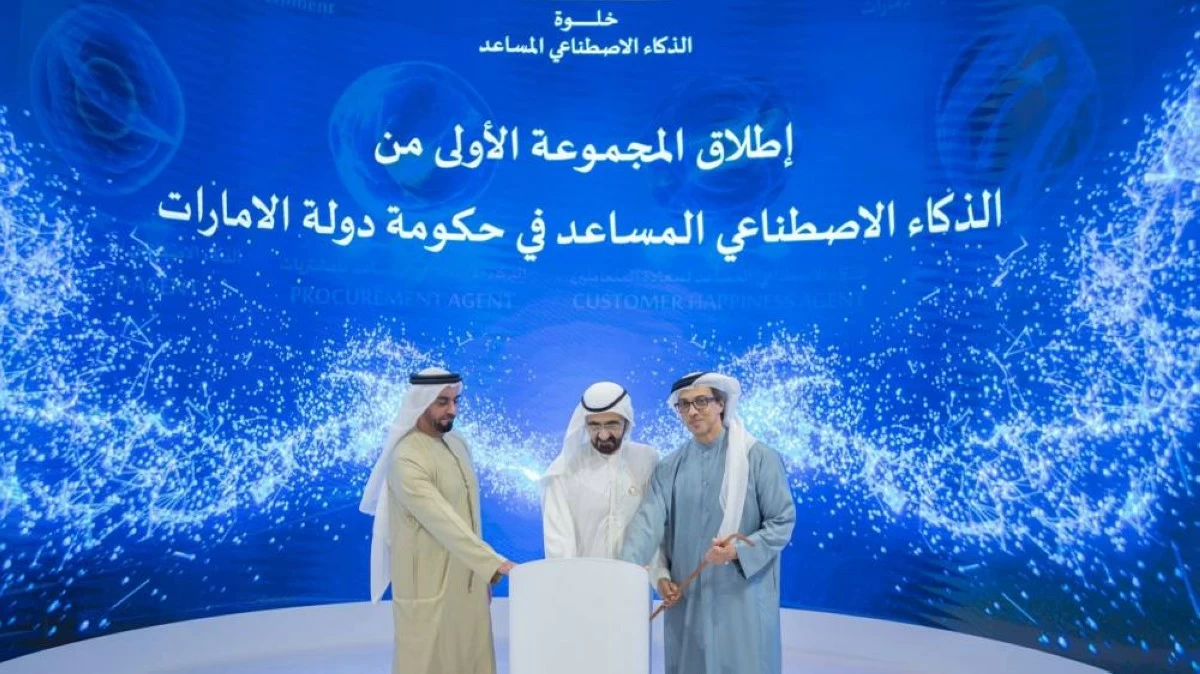
Dubai: His Highness Sheikh Mohammed bin Rashid Al Maktoum, Vice President and Prime Minister of the UAE and Ruler of Dubai, attended the UAE Government’s national Agentic AI Retreat, held in line with the directives of His Highness Sheikh Mohamed bin Zayed Al Nahyan, President of the UAE.
His Highness was accompanied by His Highness Sheikh Mansour bin Zayed Al Nahyan, Vice President, Deputy Prime Minister and Chairman of the Presidential Court, and His Highness Lieutenant General Sheikh Saif bin Zayed Al Nahyan, Deputy Prime Minister and Minister of Interior.
The Retreat brought together more than 400 ministers, federal government leaders, and media officials to present comprehensive executive plans for a national system aimed at integrating Agentic AI models into government operations, reinforcing the UAE’s global leadership in this field.
Sheikh Mohammed bin Rashid said that more than 400 ministers and senior officials are shaping and implementing the transformation of 50% of government services and operations through Agentic AI, advancing the President’s vision for the UAE to lead globally in this transition.
He added: “I attended the UAE Government’s national Agentic AI Retreat in Abu Dhabi, accompanied by HH Sheikh Mansour bin Zayed and HH Sheikh Saif bin Zayed. More than 400 ministers and senior officials are shaping and implementing the transformation of 50% of government services and operations through Agentic AI, advancing our President’s vision for the UAE to lead the world in this transition. We also launched the first cohort of AI agents covering procurement, tax audit, customer happiness, and technical support, and celebrated the graduation of a new cohort from the Federal Artificial Intelligence Programme.”
His Highness further noted that the initiative represents more than a government project, describing it as a model that will inspire the world. He emphasised that technology must serve people and enhance quality of life, reaffirming the UAE’s commitment to future generations.
During the Retreat, Sheikh Mohammed bin Rashid, accompanied by Sheikh Mansour bin Zayed, reviewed the general framework of the UAE Government’s new ecosystem as presented by ministers. He also examined practical projects and applications developed by federal entities in the field of Agentic AI.
The event featured specialised workshops and sessions aimed at enhancing the integration of Agentic AI across various aspects of government work in the coming phase. It also included the graduation of the sixth cohort of the Federal Artificial Intelligence Programme.
As part of the national initiative, the UAE Government launched its first cohort of AI agents, featuring four specialised systems powered by Agentic AI. The rollout aligns with the country’s strategic target to transition 50% of government operations and services into AI-powered models within two years.
The newly launched systems include the Procurement AI Agent, Tax Auditing AI Agent, Customer Happiness AI Agent and Technical Support AI Agent.
The Procurement AI Agent is designed to streamline sourcing procedures and optimise workflows to enhance operational efficiency. The Tax Auditing AI Agent aims to improve data verification and audit processes, strengthening compliance and reducing turnaround times.
The Customer Happiness AI Agent enables service agents to access vital information quickly, improving response times and overall service quality. Meanwhile, the Technical Support AI Agent supports IT services by resolving system challenges more effectively and ensuring the continuity of digital government services.
During a keynote session, His Excellency Dr. Sultan Al Jaber, Minister of Industry and Advanced Technology and Managing Director and Group CEO of ADNOC, outlined ADNOC’s AI transformation journey. He described the company’s shift from digital foundations to integrating AI into operations and advancing towards physical AI, robotics, and autonomous systems.
Dr. Al Jaber also announced the launch of ENERGYai, a platform connecting intelligent agents across the energy value chain. He revealed that ADNOC’s AI-powered corporate services programme now includes more than 115 AI agents across functions such as human resources, finance, procurement, and auditing.
He added that 20,000 employees have been trained to build job-specific Agentic AI models, resulting in 3,000 active models supporting daily operations. The initiative has led to an 80% adoption rate of Agentic AI within the past 90 days.
In another keynote session, His Excellency Omar Sultan Al Olama, Minister of State for Artificial Intelligence, Digital Economy, and Remote Work Applications, highlighted the role of Agentic AI as a strategic driver of global government competitiveness.
He explained that the technology is transforming government operations by enabling systems capable of independent thinking, planning, and execution, moving beyond basic automation and digitisation.
Al Olama noted that this evolution enhances decision-making speed and quality, service efficiency, and responsiveness to change. He also emphasised that early adopters of Agentic AI are likely to lead global governance and competitiveness rankings, while those slower to adopt risk falling behind.
The session underscored that, supported by advanced legislation, robust digital infrastructure, and clear leadership vision, the UAE is positioned at the forefront of building the government of the future.
A further session, titled ‘Governments in the Era of Agentic AI: Redefining the Government Work Model’, featured Luukas Ilves, Co-Founder of ‘The Agentic State’ initiative. He outlined how Agentic AI is reshaping government systems worldwide and highlighted successful practical models, along with the essential requirements for governments to redesign operations and services in response to this transformation.